
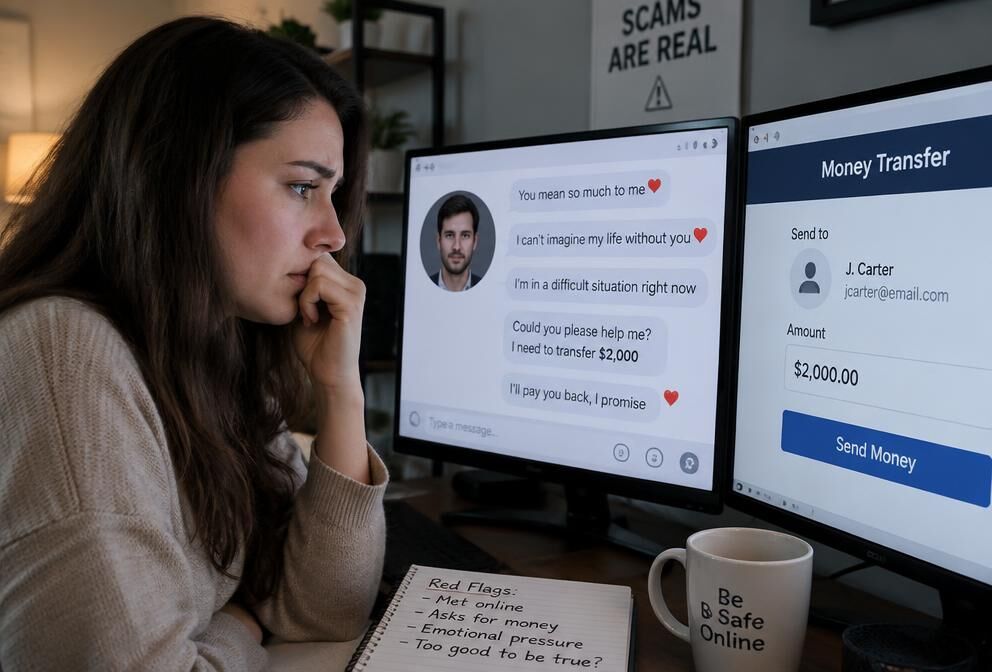
Your sister sent you an article. Your best friend said it kindly the first time and less kindly the second. A stranger in a Facebook group told you to run, in capital letters, before she knew a single fact about him.
And you love him. So now you're defending him constantly, you've started leaving things out when you talk about him, and you've become lonely inside a relationship that was supposed to make you happy.
I want to say something you probably haven't heard lately: they might be wrong. I run a community full of women whose foreign partners turned out to be exactly who they said they were, and I am with a man plenty of people warned me about. He's much younger than me, he's Moroccan, he's Muslim, and he's the person who takes care of me.
They also might be right. That's the part you can't settle by arguing with anyone, including me.
Why their opinion isn't evidence
Ask the people warning you what exactly they're basing it on. Usually it comes down to one of these:
- He's foreign, or from a country with a reputation.
- He's younger than you, and they can't imagine why he'd want you. That one says more about how they see you than how they see him.
- You met online.
- They saw a documentary.
- They know someone this happened to.
None of that is information about your man. It's a statistic wearing his face. I moderate spaces where this happens constantly, and I don't allow it, because "men from there are all liars" has never once helped a woman work out what's actually in front of her.
But here's the other half, and I need you to hear it as clearly. Love isn't evidence either. How certain you feel tells you nothing about him. Scammers are skilled precisely at producing that feeling, and intelligent, capable women get caught every day. Being sure is not the same as being right, for you or for your sister.
Move the argument to facts
There's only one way out of this, and it's not winning the debate. It's finding out.
Write down what you actually know, with proof next to it. Not what he's told you. What you've confirmed.
- His full name, and how you know it's his.
- His job. Have you seen the workplace, spoken to a colleague, seen him there on a live call?
- His family. Have you met them, live, more than once?
- Where he lives. Have you seen inside it, at different times, unannounced?
- His relationship status. How do you know he isn't married?
- Money. Has any of yours gone to him, in any form, including gifts, phone credit, crypto, or "loans"?
- Have you met in person, and did the man who arrived match the man on the phone?
The blanks in that list are not proof he's lying. They're just the work you haven't done yet, and doing it is the only thing that will end this. This article walks through how to check each one.
The two questions that cut through everything
When a woman comes to me in this exact situation, I ask two things.
Have you given him money? Not "did he ask you for money." Have you given him any, in any form? Cash, Moneygram, Western Union, gift cards, Bitcoin, or other cryptocurrency, or even gifts like iPhones, laptops, etc? If nothing has been given and nothing is being requested, you have time, and time is on your side. If money is moving, everything else on this page can wait until that stops.
What would change your mind? Give yourself an honest answer. If there is genuinely nothing he could do or fail to do that would make you reconsider, then you're not really evaluating him anymore. You're defending him. That's worth knowing about yourself before anything else.
What to say to your family
You don't have to convince them or cut them off. Try something like this:
"I hear you, and I'm not sending him money. I'm checking things properly and taking my time. I'll tell you what I find. Can we talk about something else for a while?"
That answer does two things. It shows them you're not naive, which is usually what they're actually frightened of, and it protects you from the worst outcome in this whole situation: isolation. Scammers need you cut off from the people who'd ask hard questions. Every time you pull away from your family to protect the relationship, you become easier to hurt. Stay in touch with them even while you disagree.
If it turns out they were right
Then you were lied to by someone who does this for a living. That's a crime committed against you, not a personal failing. I've been scammed myself, and I still run this website. It didn't make me stupid, and it wouldn't make you stupid either.
If you get there, here's exactly what to do next, and here's where to report it, country by country.
And if it turns out he's real
Then you'll have the receipts. You'll be able to stop defending him, your family will eventually come around, and you'll have a relationship you actually trust rather than one you're constantly arguing for.
That's the whole point of verifying. Not to catch him out. To let you relax.

From April's guides
Not sure he is who he says he is?
My How to Verify Him Guide walks you through calm, respectful ways to confirm his identity, from photos and video calls to documents, without damaging a relationship that may be completely real.

Still figuring out what's really going on?
Take the Catfish Checklist or the Visa Audit to get a clearer picture.
Your love feels real and you're ready to travel?
Find trusted flights, stays, and travel insurance on my Resources page, or get my Amazon bestseller.
Think you've been scammed?
Read what to do next, or browse all my Guides & eBooks.



0 Comments