

If you're reading this, you're probably scared for someone you love. Maybe it's your mom, who suddenly lights up every time her phone buzzes. Maybe it's your sister, who just asked to borrow money and got vague when you asked why. Maybe it's your best friend, who is talking about a man overseas she has never met in person, and something about the story is making your stomach drop.
I want to talk to you, not to her, for a few minutes. Because the way you handle the next conversation matters more than almost anything else. I've been scammed myself, so I know what it feels like from the inside. And I also know what it feels like to be on the other side of the table, where everyone around you is sure the man you love is a fraud.
Here's the hard truth up front: shaming her, giving ultimatums, or announcing "he's obviously a scammer" almost never works. It usually pushes her closer to him. Real scammers know this, and many of them prepare their targets for it ahead of time. The goal isn't to win an argument. The goal is to keep the door open so she can see the evidence for herself.
And one more thing before we start. He might be real. Being foreign, younger, or met online is not proof of anything. So let's begin with facts, not assumptions.
First, Check Your Own Assumptions
Before you say a word to her, ask yourself one honest question: what exactly is worrying me?
If your answer is "he's from Nigeria," or "he's 20 years younger," or "they met on Facebook," that's not a red flag. That's a feeling. I've traveled to nearly 100 countries and lived in eight of them, including Nigeria, Egypt, and Morocco, and I can tell you that good, loving men are everywhere. I'm happily with a much younger man from Morocco right now, and plenty of people doubted us. He's a good man who loves me and takes care of me. If my family had treated him like a criminal from day one, they would have been wrong, and they would have lost my trust.
If your answer is "he keeps asking her for money," or "he's never once done a live video call," or "she's started hiding things from us," now you have something real to look at. Those are behaviors, and behaviors can be checked.
A quick self-check
Write down your concerns. Then cross out anything that is only about where he's from, his age, his religion, how much money he has, or where they met. Whatever is left on the list is what you actually need to talk about.
It also helps to understand how this looks from her side. I wrote Everyone Says He's a Scammer, But I Love Him for women in exactly her position. Read it. That article is written for her. This one is for you. Seeing both sides will make you a much better helper.
Signs Worth Taking Seriously
Romance scams are not rare, and they are not small. In its 2025 Internet Crime Report, the FBI's Internet Crime Complaint Center counted more than 23,000 romance and confidence fraud complaints, with losses of about $929 million. People age 60 and over filed about 10,000 of those complaints but accounted for roughly $584 million of the losses. And those are only the people who reported it. Many never do, usually out of shame.
Here are the patterns that deserve a closer look. One on its own doesn't prove anything. Several together is a different story.
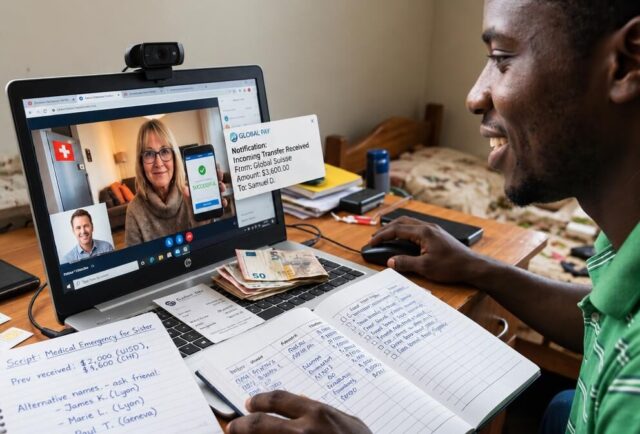
- Money requests. Especially emergencies: a medical bill, a stuck shipment, a customs fee, a frozen bank account, a plane ticket that always falls through.
- No live video, ever. A broken camera, bad internet, a job on an oil rig or a military base. Months go by and she has never seen him move and talk in real time. (More on this in He Won't Video Call: What It Means.)
- Secrecy. He asks her not to tell family, or she starts hiding the relationship, the messages, or the money.
- Isolation. He talks badly about the people who love her, or tells her they "don't understand" what the two of them have.
- Changing stories. His job, his city, his age, or his family details shift over time.
- Urgency. Everything has to happen today. There's always a deadline and a crisis.
- Unusual payment methods. Gift cards, cryptocurrency, wire transfers, crypto ATMs, or sending money through a "friend" or a "lawyer." The FTC specifically warns that anyone asking for these is a scammer.
- An investment opportunity. He's great at crypto trading and wants to help her grow her savings on a special platform.
The one that worries me most
If he has told her that her family will be jealous, won't understand, or will try to "destroy" what they have, pay attention. Scammers often coach their targets on this in advance. So when you show up worried, you walk straight into the script he already wrote. That's exactly why a gentle approach works better than a loud one.
It's just as important to notice the good signs. Does he video call regularly? Has he introduced her to his family or friends on camera? Has he never asked for money, or even refused it? Is he making real plans to meet, and following through? I cover these in Green Flags in an International Relationship: 12 Signs He's Actually Real. If you see a lot of those, you may be dealing with a real relationship that just makes you uncomfortable, and that's a different conversation.
Why Smart, Loving People Get Scammed
The first thing many family members say is "How could she fall for this? She's so smart." I understand the reaction. But please let go of the idea that this happens to foolish people. It happens to nurses, teachers, executives, and women who swore it could never happen to them.
Scams don't work on intelligence. They work on the heart. And the people with the biggest hearts are often the easiest to reach.
- Loneliness. After a divorce, an empty nest, or years of being single, feeling chosen again is powerful.
- Grief. Widows are targeted on purpose. Someone kind shows up at the exact moment the house feels unbearably quiet.
- Hope. She wants this to be real. Wanting love is not a weakness.
- The drip, drip of daily attention. Good morning texts. Good night texts. Questions about her day. Over weeks and months, that attention becomes part of her routine and her nervous system. Walking away feels like losing a limb.
For some women, the constant contact starts to feel a bit like an addiction, and that makes it even harder to step back. If that sounds familiar, my article on love addiction and why it can make you a target explains what's going on in a way that may help you feel more patient with her.
What to Say (and What Not to Say)
Your words decide whether she lets you in or shuts you out. When people feel attacked, they defend. When they defend, they dig in. So your job is to sound like a teammate, not a prosecutor.
Lead with curiosity. Ask more than you tell. And talk about specific things you noticed, not about who he is as a person.
| Instead of saying... | Try saying... |
|---|---|
| "He's obviously a scammer." | "I can see how happy he makes you. Can you tell me more about him?" |
| "How could you be so stupid?" | "These scams fool really smart people. I'd want someone to double check for me too." |
| "If you send him one more dollar, I'm done." | "I'm not going anywhere, no matter what. Can we talk before any more money goes out?" |
| "Men from over there only want one thing: your money." | "I don't know him yet. I'd love to. Could I say hi on your next video call?" |
| "He's just after a visa." | "What are you two planning for the future? How are you thinking about the visa side?" |
| "You're embarrassing the family." | "I love you and I worry because I love you. That's all this is." |
| "I told you online dating was dangerous." | "Lots of real couples meet online. Want to look at a few ways people check that it's real?" |
| "Show me the messages right now." | "You don't have to show me anything. But if you ever want a second set of eyes, I'm here." |
| "He doesn't really love you." | "Your feelings are real. I just want to make sure his story is too." |
| "I'm calling the police on him." | "If anything ever feels off to you, I'll help you figure out who to talk to. You won't be alone." |
A few more things that help:
- Pick the right moment. Not at a holiday dinner with the whole family watching. One on one, somewhere calm.
- Keep it short. One gentle question can sit in her mind for days. A two hour lecture gets forgotten by morning.
- Don't insult him. Every time you attack him, she has to defend him, and each defense makes her belief stronger.
Practical Ways to Help Her Check, Without Accusing Anyone
Here's the secret: people believe what they discover far more than what they're told. So instead of trying to prove he's fake, offer her easy, low pressure ways to check for herself. If he's real, these checks will show it. If he isn't, she'll see it with her own eyes, and that's the only kind of proof that sticks.
Offer to do a reverse image search together
"Have you ever tried a reverse image search? It's wild what it turns up. Want to try it on a few photos, including mine?" Upload his photos to Google Images, Google Lens, Bing Visual Search, or TinEye. If his pictures show up under a different name, on a model's Instagram, or on scam warning sites, she'll see it right there. If nothing comes up, that's a good sign worth saying out loud. My guide on how to vet and background check your online lover walks through more ways to do this.
Suggest a private quiz she can take alone
Some women won't answer honest questions in front of family, but they will answer them alone, at 2 a.m., on their phone. That's why I built two free tools you can simply send her with a kind note:
- The Scam Probability Calculator: 95 questions that look at money, communication, and consistency, and weigh the green flags along with the red.
- The Catfish Quiz: a shorter check on whether he is who he says he is.
Tell her you don't need to know the results. That's important. The point is for her to see her own answers, without anyone watching.
Ask to say hello on a live video call
This is the simplest and kindest test there is. "I'd love to meet him. Could I pop in and say hi next time you two video chat?" A genuine partner will usually be happy, maybe nervous, but happy, to meet the people she loves. If there's always a reason he can't, the camera is always broken, or the call is always audio only, she will notice that too.
If the checks come back clean
If his photos are his own, he video calls happily, he's met her friends on camera, and he's never asked for money, give yourself permission to relax a little. Tell her so. "I'm glad I got to meet him" can mean the world to a woman who expected her family to hate him.
If Money Is Already Involved
Here, time matters. The FTC reported in December 2025 that fraud losses reported by adults 60 and over grew from about $600 million in 2020 to $2.4 billion in 2024, driven largely by losses over $100,000, often to investment scams, romance scams, and impersonators. Here's what you can do, step by step.
- Help her pause further transfers. She doesn't have to break up with him today. Ask for something smaller: "Could we agree no more money goes out until we've looked at this together?" A pause is much easier to say yes to than a goodbye.
- Call her bank together. If money went out recently, especially by wire or bank transfer, the bank's fraud department should hear about it as soon as possible. Sometimes a transfer can still be stopped or flagged. Many banks also have fraud teams trained to talk with customers who are being targeted, and some can add alerts or a trusted contact to her account if she agrees.
- Save the evidence. Screenshots of his profile and messages, usernames, phone numbers, email addresses, receipts, gift card numbers, wire confirmations, crypto wallet addresses. Save them somewhere safe before anything gets deleted. My Financial Scam Evidence Guide (linked at the bottom of this article) walks through how to organize all of it.
- Report it. In the US, that means the FBI's IC3 and the FTC at ReportFraud.ftc.gov, plus the dating site or app where they met. Outside the US, use my country by country guide to reporting a romance scammer.
- Get help if she's an older adult. In the US, the National Elder Fraud Hotline, run by the Department of Justice's Office for Victims of Crime, is free at 1-833-FRAUD-11 (1-833-372-8311), Monday through Friday, 10 a.m. to 6 p.m. Eastern. Callers get a case manager who can help with reporting and local resources, and family members concerned about an older adult can call too.
For the full picture of what comes next, including protecting her accounts and identity, send her my article on what to do if you've been the victim of a romance scam.
Watch out for recovery scams
Once someone has lost money, the second wave arrives. A "lawyer," "investigator," "government agent," or "crypto recovery expert" contacts her promising to get the money back, for an upfront fee. The FTC is clear: anyone who asks you to pay upfront to recover lost money is a scammer. Warn her about this early, before it happens, so she recognizes it.
When She Won't Listen
Sometimes you do everything right and she still defends him. She may get angry, stop answering your calls, or tell you she's marrying him. This is the hardest part, and I'm so sorry if you're living it.
Stay close
Your relationship with her is the lifeline. If a scam is happening, there will almost always be a moment when the story cracks: another emergency, a lie she can't explain, a video call that never comes. When that moment arrives, she needs to know she can call you without hearing "I told you so." Keep inviting her to lunch. Be the person she doesn't have to defend him to.
Skip the ultimatums
"Him or us" feels powerful in the moment. But if she picks him, and scam victims often do, you've just handed him exactly what he wanted: a woman with no one left to question him. Hold your boundaries without cutting her off.
Protect yourself, too
Loving her doesn't mean funding him. It's okay to say, "I love you, and I'm not able to lend money right now." It's okay not to co-sign loans, share your bank details, or send money "for her" that ends up with him. It's okay to take breaks when it's hurting you. This could be a long road.
Know when to bring in professionals
If large amounts of money are leaving her accounts, talk to her bank (ideally with her). If there are threats, blackmail, or someone is in danger, contact local police. If she's an older or vulnerable adult who may not be able to protect herself, your local Adult Protective Services agency can look into financial exploitation. The rules and options are different in every state and country, so ask the agency or a professional what applies to her situation rather than guessing.
A gentle reality check
If she is a competent adult, she has the right to make her own choices, even ones you don't like, and even about a relationship you're wrong about. Professionals step in when there's exploitation or someone can't protect themselves, not simply because the family disapproves.
After It Ends: Helping Her Heal
If it was a scam, the day she realizes it will be one of the worst of her life. She's not only losing money. She's losing a person she loved, a future she pictured, and some of her trust in herself. It's a real grief, even if he was never real.
I remember how ashamed I felt when it happened to me. What I needed most was someone who didn't make me feel stupid.
- Never say "I told you so." Not even as a joke. Not even once. She is already saying it to herself.
- Let her grieve him. She may miss him. That's normal. The feelings were real even if he wasn't.
- Help with the practical stuff. Reports, bank calls, changing passwords. Sit next to her while she does it.
- Watch for recontact. Scammers often come back with new sob stories, or pose as someone who can "help" her.
- Watch her mood. Shame and loss can hit hard. If she seems deeply depressed or talks about not wanting to go on, get her connected with a doctor or counselor right away. In the US, you can call or text 988 any time.
My article What to Do If You've Been the Victim of a Romance Scam is a good one to share with her once she's ready. It's written to her, with no blame at all.
You Don't Have to Figure This Out Alone
Sometimes a neutral voice from outside the family is exactly what's needed. She might listen to someone who has lived it and has no stake in the outcome.
I offer private 30-minute coaching calls. She can book one on her own, or the two of you can join together. I'll look at the facts calmly, point out the green flags as well as the red ones, and help her decide what to check next. No judgment, no lectures. You can also book a call just for yourself, if you need help planning how to talk to her.
FAQ
How do I tell my mom she's being scammed without upsetting her?
Don't lead with "you're being scammed." Lead with love and questions. Ask about him, ask to say hello on a video call, and offer tools she can use privately, like a reverse image search or the Scam Probability Calculator. Let her reach the conclusion herself. It will stick far better than anything you tell her.
What if he's actually real?
Then checking the facts will show that too, and you'll have protected your relationship with her by staying respectful. Plenty of international, age gap, and online relationships are completely genuine. Look for green flags like regular live video, meeting in person, openness with her family, and no money requests.
Why won't she believe me when the evidence is so obvious?
Because believing you would mean losing someone she loves, and possibly admitting to losing money. That's incredibly painful, so the mind protects itself. Scammers also often warn their targets that family will be jealous or against them. Pushing harder usually confirms his story. Patience and closeness work better.
Can the bank stop her from sending money?
Banks can't usually block a competent adult from spending her own money, but their fraud teams can often flag suspicious transfers, try to recall recent ones, and talk to her about scam warning signs. Contact the bank quickly, ideally together with her. Policies vary by bank and country, so ask them directly what they can do.
Can she get her money back?
Sometimes, especially if the bank is told quickly after a transfer. But often it's hard to recover, particularly with gift cards and cryptocurrency. Report to the bank, IC3, and the FTC right away. And be very careful of anyone who promises to recover the money for a fee. That's a recovery scam.
Who can I call if my elderly parent is being scammed?
In the US, the National Elder Fraud Hotline at 1-833-FRAUD-11 (1-833-372-8311) is free and run by the Department of Justice's Office for Victims of Crime. You can also contact her bank, local police if there are threats, and your local Adult Protective Services if she's vulnerable and being financially exploited.
Loving someone through this is exhausting, and the fact that you're here, reading, learning how to do it gently, tells me she's lucky to have you. Keep the door open. Keep your voice soft. Whether he turns out to be a good man or a stranger behind a screen, the most important thing is that she knows she can always come home to you. With love, April.

From April's guides
Worried about money she's already sent?
My Financial Scam Evidence Guide helps you and her organize what you have, understand what really happened, and choose the next step without panic or blame.

Still figuring out what's really going on?
Take the Catfish Checklist or the Visa Audit to get a clearer picture.
Your love feels real and you're ready to travel?
Find trusted flights, stays, and travel insurance on my Resources page, or get my Amazon bestseller.
Think you've been scammed?
Read what to do next, or browse all my Guides & eBooks.

0 Comments