
If you learned about romance scams five or ten years ago, some of what you learned is still true. Some of it will get you hurt. The man with the broken English, the stolen soldier photos, and the camera that is always "broken" still exists. But he now has company: polished, patient, well-organized teams using AI, fake trading apps, and scripts refined on thousands of women before you.
I have been scammed myself, so I know how real it feels from the inside. I also know the other side. Today I am happily in love with a much younger man from Morocco, a relationship plenty of people were sure was a scam. It wasn't. That is why I write the way I do: I want you to see clearly, not live in fear.
This guide walks you through how romance scams actually work in 2026, what has changed, what hasn't, and how to calmly check the person you are talking to. Most people you meet online are exactly who they say they are. The goal here is to help you spot the ones who aren't, without treating every good man like a suspect.
The numbers behind romance scams right now
The FBI's 2025 Internet Crime Report recorded 23,159 complaints of confidence and romance fraud, with about $929 million in reported losses. That same year, investment fraud (where many modern romance scams end up) topped $8.6 billion in reported losses, and cryptocurrency investment fraud alone accounted for about $7.2 billion.
The FTC sees the same picture from a different angle. Consumers reported losing $15.9 billion to fraud in 2025, with investment scams causing the biggest losses at $7.9 billion. And according to the FTC's April 2026 data spotlight, nearly 60% of people who lost money to a romance scam in 2025 said it started on social media.
Keep in mind these are only the people who reported. Many women never tell anyone, because they feel ashamed. If that is you, please hear me: scams work on smart, loving, capable women. They are built to.
Why romance scams look different now
The biggest change isn't technology. It's organization. Many romance scams today are not run by one lonely con artist. They are run like businesses.
Scam compounds and trafficked workers
In February 2026, the UN human rights office published a report on scam centers in Southeast Asia, covered by UN News. It estimates that at least 300,000 people have been forced to work in scam operations, trafficked from more than 66 countries. Many were lured by fake job ads, then had their passports taken and were forced to run romance and crypto scams under quotas, sometimes for up to 19 hours a day. The compounds are concentrated in the Mekong region, but similar operations have spread to other parts of the world.
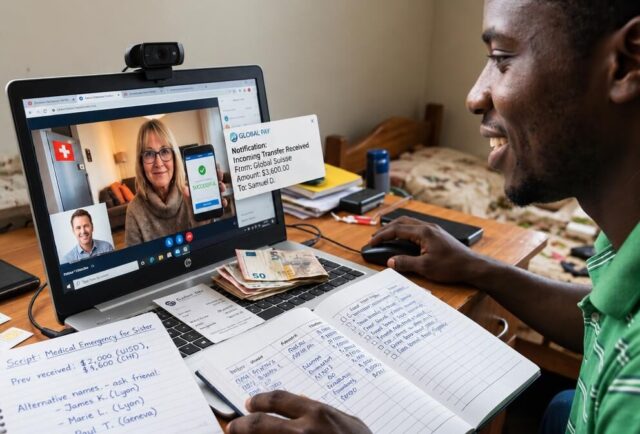
This matters for you in a very practical way. The person writing to you may not be the person in the photos, and may not even be one person. It can be a team, working shifts, sharing notes about you in a spreadsheet, and following a script that has been tested on thousands of women.
Scripts and teams working one profile
Scripts explain some of the strange things women often notice only later: the "good morning, my queen" message at the exact same time every day, a slight change in tone on weekends, a detail he "forgot" that you told him last week, or a story that shifts when a different person takes over the chat. On their own, these are small things. Real people forget details too. But together, and alongside other signs, they paint a picture.
Key point
A scam is defined by what happens, not by who he is. Where he is from, his age, his religion, or how you met are never proof of anything. Pressure, secrecy, stories that don't add up, and requests for money are what you are watching for.
AI in romance scams: what's real and what isn't
The FBI has warned since its December 2024 public service announcement that criminals use generative AI to write messages, create realistic profile photos, clone voices, and even produce video to "prove" they are a real person. Its 2025 report counted 22,364 AI-related complaints with nearly $893 million in losses. Here is how that shows up in romance scams.
- AI-generated profile photos. Faces that belong to no one, so a reverse image search finds nothing. A clean search used to be reassuring. Now it only means the photo wasn't obviously stolen.
- AI-written messages. The broken English that used to give scammers away is gone. Messages can be fluent, romantic, and tailored to things you've shared.
- Voice cloning. A short voice note can be generated to match a face or to sound like someone in distress.
- Deepfake and face-swapped video calls. Live face-swap software can put a stolen or generated face over someone else's in real time. These calls are often short, dim, or "laggy," and end quickly.
How to test a video call, calmly
You don't need to interrogate anyone. A genuine man will usually find these requests easy, even fun. Weave them into a normal, relaxed conversation:
- Ask him to turn his head slowly to the side. Face-swap filters often blur, warp, or flicker at the edges of the face and around the ears in profile.
- Ask him to pass his hand in front of his face. Many filters glitch when something covers part of the face.
- Ask him to show you around, live. The view out the window, the street, what he's cooking. Real life is messy and specific.
- Call at a time you didn't plan together. A real person may be busy, but he'll pick up or call back soon in the same everyday setting. A scam team needs time to set up.
- Ask for something personal and specific. Say your name and today's date, hold up a note you asked for, or wave with his left hand. Small, unscripted moments are hard to fake.
Be honest with yourself
No video test is foolproof. Deepfake tools keep improving, and a good call is not a guarantee. A video call is one piece of evidence, not a verdict. It works best alongside other checks: consistent stories over time, real friends and family you can see, and no requests for money.
And if he never video calls at all, that is its own conversation. I explain the innocent and not-so-innocent reasons in He Won't Video Call: What It Really Means.
"Pig butchering": the romance scam that looks like investing
This is the scam I most want you to understand, because it doesn't look like a romance scam at all. The name comes from the scammers themselves: they "fatten" the victim with attention and trust before taking everything. The FBI describes the pattern on its cryptocurrency investment fraud page, and it usually goes like this:
- The slow build. Weeks or months of friendship or romance. He never asks for money. He's successful, generous with his time, and interested in your life.
- The casual mention. He talks about his trading, his uncle's crypto strategy, or an app that "changed his life." He doesn't push. He just lets you notice.
- The helpful offer. He offers to show you how. He walks you through downloading an app or opening an account on a site that looks completely professional.
- The fake profits. You start small. The dashboard shows impressive gains. You may even be allowed to withdraw a little, which makes it feel safe.
- The bigger deposit. A "special window" or "VIP level" encourages you to put in more, sometimes from retirement savings, loans, or home equity.
- The trap. When you try to take your money out, the account freezes. Now you owe "taxes," "fees," or a "security deposit" before you can withdraw. Every payment leads to another one.
The numbers on that screen were never real. The platform belongs to the scammers. The FBI is clear on this: paying the withdrawal "fee" or "tax" does not release your money.
Red flag
Anyone you met online who guides you toward a specific investment app, website, or crypto platform. It doesn't matter how long you have known him or how loving he is. Real partners don't need to manage your money to love you.
The classic patterns that are still going strong
New tricks haven't replaced the old ones. These still work, which is exactly why they are still used. I break down the exact wording in Exposing Scammers' Most Popular Lines and Lies, but here are the patterns to know.
- The man who can't be reached: a soldier on a peacekeeping mission, an engineer on an oil rig, a doctor with an aid group abroad, a ship captain. The job explains why he can't video call, can't meet, and can't access his own money.
- The sudden emergency: a hospital bill, an accident, a stolen wallet, a child who needs surgery. Always urgent, always just this once.
- Customs and shipping fees: he sent you a package, gold, or cash, and now a "customs officer" or "courier" says you need to pay to release it.
- Inheritance, gold, or a contract payout: a fortune he'll share with you, as soon as a legal fee is paid.
- Fake officials: a "lawyer," "diplomat," "bank manager," or "immigration agent" who contacts you to confirm the story and collect a fee.
- Gift cards, wires, and crypto ATMs: payment methods that are fast and very hard to reverse. A request to pay this way is a warning sign all on its own.
- Money mule requests: he asks you to receive money into your account and send it on, or to open an account for him. This can make you part of a crime without realizing it. The FBI explains the risks on its money mules page.
- Sextortion: a request for private or intimate images, followed by threats to share them unless you pay. If this is happening, remember that agencies like the FBI advise against paying, and don't blame yourself. My online dating safety tips cover how to protect yourself, and my Sextortion & Digital Safety Guide walks you through what to do step by step.
If money is already part of your relationship, read why you shouldn't give your foreign lover money or gifts early on. It isn't about suspicion. It's about keeping love and money separate until trust is earned in person.
Recovery scams: the second hit
This one breaks my heart, because it targets women who have already been hurt. After a loss, you may be contacted by someone promising to get your money back: a "recovery firm," a "crypto tracing expert," a "lawyer," or even someone claiming to be from the FBI or a government agency. Sometimes they find you after you post about your experience online. Sometimes they are the same criminals who scammed you in the first place.
They ask for an upfront fee, a "tax," or access to your accounts. Then they disappear, or ask for more.
Important warning
In a July 2026 alert, the FBI said plainly that IC3 will never contact individuals directly by phone, email, social media, or chat, and will never ask for payment to recover lost funds. It also warned that criminals are using deepfake videos and fake websites to pose as IC3. Anyone who guarantees to recover your money for a fee should be treated as a scammer until proven otherwise.
Where scammers find women now
Dating sites are still used, but they are no longer the main door. Here is where first contact often happens today:
- Dating apps, usually with a quick push to move to WhatsApp, Telegram, or Google Chat, away from the app's safety tools.
- Facebook, through friend requests, comments, and messages. The FTC says people reported more losses to scams on Facebook than any other platform in 2025.
- Instagram, often a like or kind comment on your photos, followed by a DM.
- "Wrong number" texts on WhatsApp or SMS. "Hi, is this Linda?" You politely say no, and a friendly chat begins. The FTC's advice on these "hi, how are you?" texts is simple: it isn't rude to ignore them.
- LinkedIn, where a "successful professional" connects over work and slowly turns personal, or turns to investing.
- Online games and word-game apps, where chat features make friendly conversation feel natural.
- Facebook groups for widows, grief support, hobbies, faith, travel, and pets, where people share personal details openly.
Meeting someone in any of these places is normal. Real couples meet on Facebook and in games all the time. It's simply smart to know where the patterns tend to start.
Old playbook vs. 2026 playbook
| Old playbook | 2026 playbook | |
|---|---|---|
| Who's writing | One man working alone | Teams on shifts following scripts, sometimes trafficked workers in scam compounds |
| Photos | Stolen from a real person's social media | Stolen photos plus AI-generated faces that reverse image search can't find |
| Video calls | Always avoided: "my camera is broken" | Short, dim, glitchy calls using face-swap or deepfake video |
| Messages | Broken English, copy-paste love poems | Fluent, AI-polished messages tailored to your interests |
| First contact | Dating sites | "Wrong number" texts, Instagram, LinkedIn, games, Facebook groups |
| Pace | "I love you" in the first week | Patient for weeks or months; may stay "just friends" |
| The ask | Emergency wire, customs fee, gift cards | "Let me show you how I invest" on a fake trading app |
| After the loss | He disappears | "Fees" to withdraw, then fake recovery agents or fake officials |
What a genuine long-distance partner looks like
After reading all of that, it's easy to look at the man you love and feel a knot in your stomach. So let me say this clearly: most people in long-distance and international relationships are real. I have lived in eight countries, including Nigeria, Jamaica, Egypt, and Morocco, and I have seen firsthand how quickly good men get written off as scammers simply because of where they were born. That isn't fair to them, and it isn't fair to you.
Here is what real tends to look like:
- He video calls regularly, including unplanned calls, from ordinary places that match his story.
- His life has other people in it: friends, coworkers, family you can see and sometimes talk to.
- His story stays consistent over months, and small details match up.
- He is working toward meeting in person, with real, specific plans.
- He respects your "no," especially about money, without guilt trips or sulking.
- He is patient when you want to verify things, because he has nothing to hide.
- He never pushes you toward an investment, a platform, or secrecy from your family.
Green flag
A real partner may feel a little hurt that you want to verify him, but he'll understand once you explain. A scammer will get angry, twist it into proof that you don't love him, or suddenly have an emergency.
For the full list, read Green Flags in an International Relationship: 12 Signs He's Actually Real.
What to do if you suspect a romance scam
If something feels off, breathe. You don't have to decide everything today. Take it one step at a time.
1. Don't lead with accusations
If he is genuine, an accusation can badly hurt a good relationship. If he is a scammer, it tells him to change tactics or pull you in harder. Instead, quietly gather information first. Ask calm, curious questions and suggest ordinary checks, like a video call or a first meeting.
2. Stop sending money
Pause all payments, deposits, and gift cards while you look into things. If you have already sent money, contact your bank, card company, or the payment service right away. Speed matters.
3. Save everything
Take screenshots of his profiles, messages, phone numbers, usernames, wallet addresses, trading platform pages, and payment receipts. Save them somewhere safe before anything gets deleted.
4. Verify, gently
Use the video call tests above, run his photos through reverse image search, and check that his job, location, and friends line up. My guide on how to vet and background check your online lover walks through each step. If you want a structured second opinion, take the Scam Probability Calculator. It's 95 questions that weigh green flags and red flags together, so you get a fair picture.
5. Report it
Reporting helps investigators connect cases and can help others. In the US, that means IC3.gov and ReportFraud.ftc.gov, and you should also report the profile to the app or platform. If you live elsewhere, my country-by-country guide to reporting a romance scammer lists where to go. If you've already lost money, read what to do if you've been the victim of a romance scam for the next steps.
You don't have to do this alone
If you're stuck between your heart and your gut, a private 30-minute coaching call with me can help you sort through the evidence calmly, without judgment, whichever way it points.
FAQ
Can a scammer really fake a live video call?
Yes. Real-time face-swap tools exist, and the FBI has warned that criminals use AI-generated video to "prove" they are real. Asking him to turn his head, pass a hand over his face, and show his surroundings live can reveal glitches, but no test is perfect. Treat a video call as one piece of the picture.
What is pig butchering in a romance scam?
It's a long-game scam where someone builds a friendship or romance, then introduces you to a crypto or trading platform. The app shows fake profits, and when you try to withdraw, you're told to pay taxes or fees first. The money is never released.
He has never asked me for money. Does that mean he's real?
It's a very good sign, but not proof on its own. Some modern scams never ask for money directly. Instead, he'll offer to help you invest. If he never asks for money and never steers you toward investments, and the other green flags are there, that's reassuring.
Can a company or hacker recover the money I lost?
Be extremely careful. People who contact you promising recovery for an upfront fee are very often scammers themselves. The FBI says IC3 never charges to recover funds and never refers victims to companies that do. Report your loss to IC3 and your bank, and talk to a licensed attorney if you want legal options.
Is a reverse image search still worth doing?
Yes. Many scammers still use stolen photos, and a search can uncover them in minutes. Just remember that a clean result no longer proves much, since AI can create faces that exist nowhere else online.
Should I confront him if I think he's a scammer?
Not first. Stop sending money, save your evidence, and verify quietly. If you do talk to him, stay calm and ask for simple things a real partner can easily do. His reaction will tell you a lot.
Why do so many romance scams start with a wrong number text?
Because it feels innocent. Replying politely to a stranger is kind, and that kindness opens the door to a friendly chat that slowly becomes personal, and often turns to investing. It is perfectly fine to ignore or delete texts from numbers you don't know.
Scams have changed, but so has your ability to see them. You don't need to be suspicious of everyone to be safe. You just need to know the patterns, keep your money separate until trust is earned in person, and give a good man the chance to show you he's real. Most of them will. And if yours doesn't, you'll know sooner, with your savings and your heart in far better shape.

From April's guides
Not sure he is who he says he is?
My How to Verify Him Guide walks you through calm, respectful ways to confirm his identity, from photos and video calls to documents, without damaging a relationship that may be completely real.

Still figuring out what's really going on?
Take the Catfish Checklist or the Visa Audit to get a clearer picture.
Your love feels real and you're ready to travel?
Find trusted flights, stays, and travel insurance on my Resources page, or get my Amazon bestseller.
Think you've been scammed?
Read what to do next, or browse all my Guides & eBooks.

0 Comments