
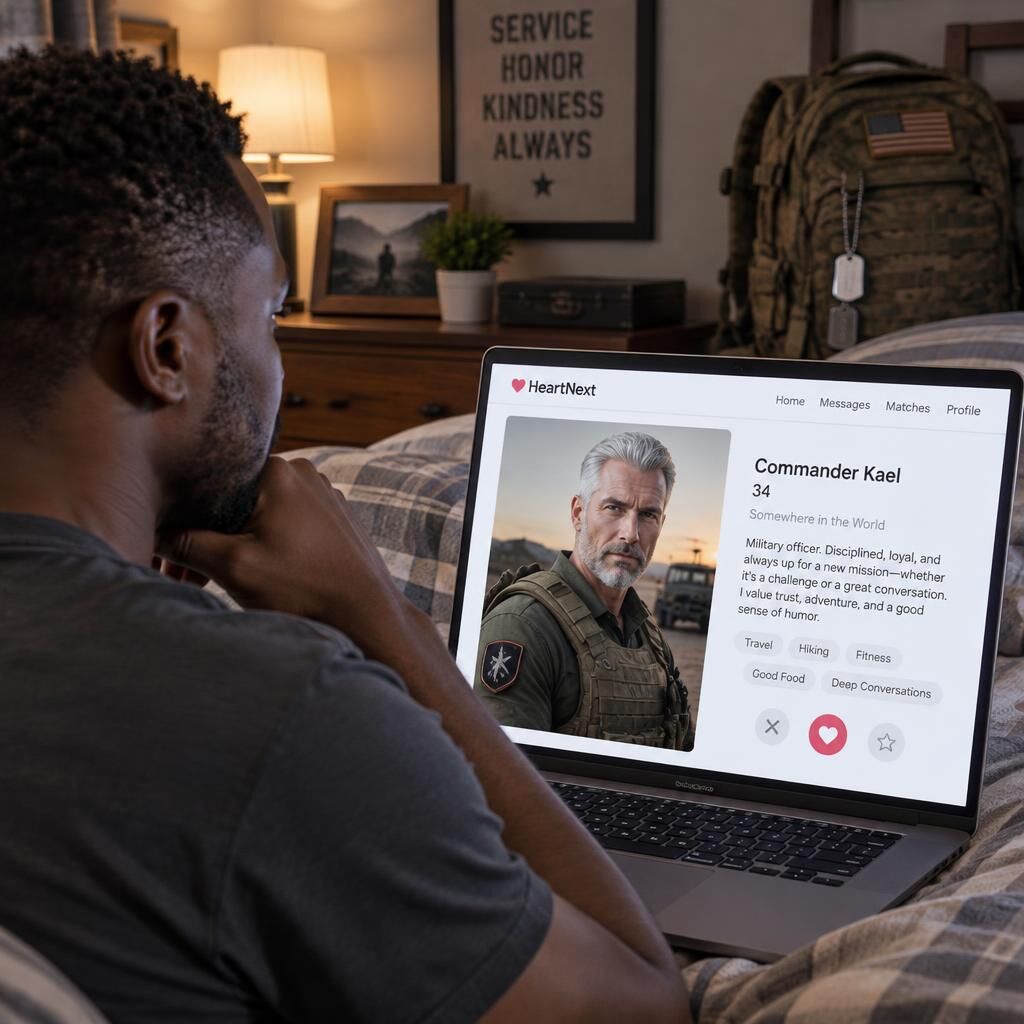
I hear from women almost every week whose new love interest happens to be a soldier deployed overseas, or an engineer working on an oil rig somewhere off the coast. My first question is always the same: is this a real person going through a normal, frustrating deployment or rotation, or is this a script someone is running on you?
Before I go any further, I want to say this clearly. There are thousands of real service members and real offshore workers who date and fall in love online, just like anyone else. Being deployed or working a rig does not make a man a scammer. Plenty of genuine relationships start exactly this way, with someone stationed far from home doing his best to stay connected. This article is not about treating every soldier or rig worker as a suspect. It is about understanding why scammers love borrowing these two identities, so you can tell a real deployment story from a fake one.
Why scammers keep reaching for these two jobs
Scammers are lazy in a specific way. They do not want to invent a new cover story every time, so they reach for one that comes with built in excuses already attached. Military service and offshore work both do that job perfectly.
A scammer needs a reason he cannot video call. He needs a reason communication is spotty and unpredictable. He needs a reason you cannot just show up, meet his friends, or see where he actually lives. And he needs all of that to sound respectable instead of evasive. A deployed soldier or an offshore engineer hands him all of that in one tidy package, and it sounds noble instead of suspicious. Nobody wants to seem like they are doubting a man serving his country or working a dangerous job far from home. That hesitation is exactly what the scammer is counting on.
Here is the part that matters most. Real service members are genuinely restricted by operational security. Real offshore workers genuinely have limited internet on some rigs and vessels. The isolation is real for legitimate people too, which is exactly why this scam works so well. You are not looking for someone who claims to be isolated. You are looking for whether the rest of his story holds up under gentle, specific questions.
What to check with a military persona
A genuine service member will not always be able to tell you exactly where he is or share operational details, and that is normal, not a red flag by itself. What is worth paying attention to is how he handles the parts that are not actually secret.
- He avoids ever naming his base, unit, or branch, even in general terms, and gets vague or annoyed when you ask.
- He tells you he needs money for leave papers, a satellite phone, or to get equipment released. The military does not charge service members for leave, and it does not require families to pay fees to bring someone home.
- He asks you to communicate only through a personal email or messaging app and gets defensive if you mention checking anything through official channels.
- His photos show a uniform that does not quite match his claimed rank, unit patches, or branch, or the same face keeps showing up under different names in a reverse image search.
- He claims to be a general or high ranking officer very early on. High ranking officers exist, but scammers overuse this rank because it explains away a lot of inconsistencies and makes the target feel special.
- He describes a mission that keeps shifting when you ask follow up questions about it days apart.
None of these by themselves prove a scam. Together, especially alongside a request for money, they are worth taking seriously.
What to check with an oil rig or offshore persona
Real offshore and oil rig workers have something scammers usually skip over: a verifiable employer. Rigs are run by real companies with real HR departments, real rotation schedules, and real ways to confirm someone works there.
- He cannot or will not name the company he works for, or the name he gives does not turn up anywhere when you search it.
- He describes his rotation schedule vaguely, or it keeps changing, instead of the fairly predictable weeks-on weeks-off pattern most offshore contracts run on.
- He needs money for a customs fee, a repair on equipment, or a contract buyout to come home early. Legitimate oil companies cover their own equipment and do not bill an employee's girlfriend for it.
- He has no coworkers, supervisor, or company contact he is willing to put you in touch with, even loosely, and no company email address.
- His photos look more like stock imagery or modeling shots than the kind of casual, slightly rough photos people on an actual rig tend to take.
How a real person responds differently when you ask to verify
This is the part I think matters most, because it is where the two groups split clearly. A genuine service member or offshore worker who is asked to verify himself, calmly and respectfully, generally reacts with patience. He might not be able to give you everything you ask for right away because of real restrictions, but he does not punish you for asking. He offers what he can. Maybe that is a video call once he is back on base or back on land. Maybe it is a company contact, even if it takes a few weeks to arrange. Maybe it is simply, I understand why you are being careful, ask me anything.
A scammer reacts to the same request very differently. He gets hurt, or accuses you of not trusting him after everything you have shared together. He speeds up the emotional pressure instead of answering the question. He offers a reason verification is impossible right now, and then another reason next month, and it never actually happens. Watch the pattern over time rather than judging any single answer on its own. A real person's story gets more solid the more you ask. A fake one gets more elaborate, and somehow always stays just out of reach.
If you want a structured way to walk through this instead of guessing, my guide to verifying someone you met online walks through the actual steps, and the scam probability calculator can give you a fast gut check based on what has happened so far.
Why I take this personally
I have been scammed myself, so I know exactly how convincing and how comfortable these stories can feel from the inside. I also happen to be happily with a man who is much younger than me, from Morocco, a Muslim country. On paper he checks a few of the boxes people are told to worry about: younger, foreign, met online. In real life he is a good man who loves and takes care of me. I say that because I want you to hear this from someone who genuinely believes good, real relationships cross borders and age gaps all the time. My goal was never to make you suspicious of every man in uniform or every man on a rig. It is to help you tell the difference calmly, without fear running the show.
If you are in the middle of one of these situations right now and you are not sure which way it is leaning, you do not have to sort it out alone. I offer a private coaching call where we can go through the specifics together.

From April's guides
Deployed, offshore, or hiding behind the story?
If someone in your life always has a reason he cannot video call or meet, this guide walks you through exactly how to verify a military or offshore claim step by step, calmly and without guessing.

Still figuring out what's really going on?
Take the Catfish Checklist or the Visa Audit to get a clearer picture.
Your love feels real and you're ready to travel?
Find trusted flights, stays, and travel insurance on my Resources page, or get my Amazon bestseller.
Think you've been scammed?
Read what to do next, or browse all my Guides & eBooks.



0 Comments